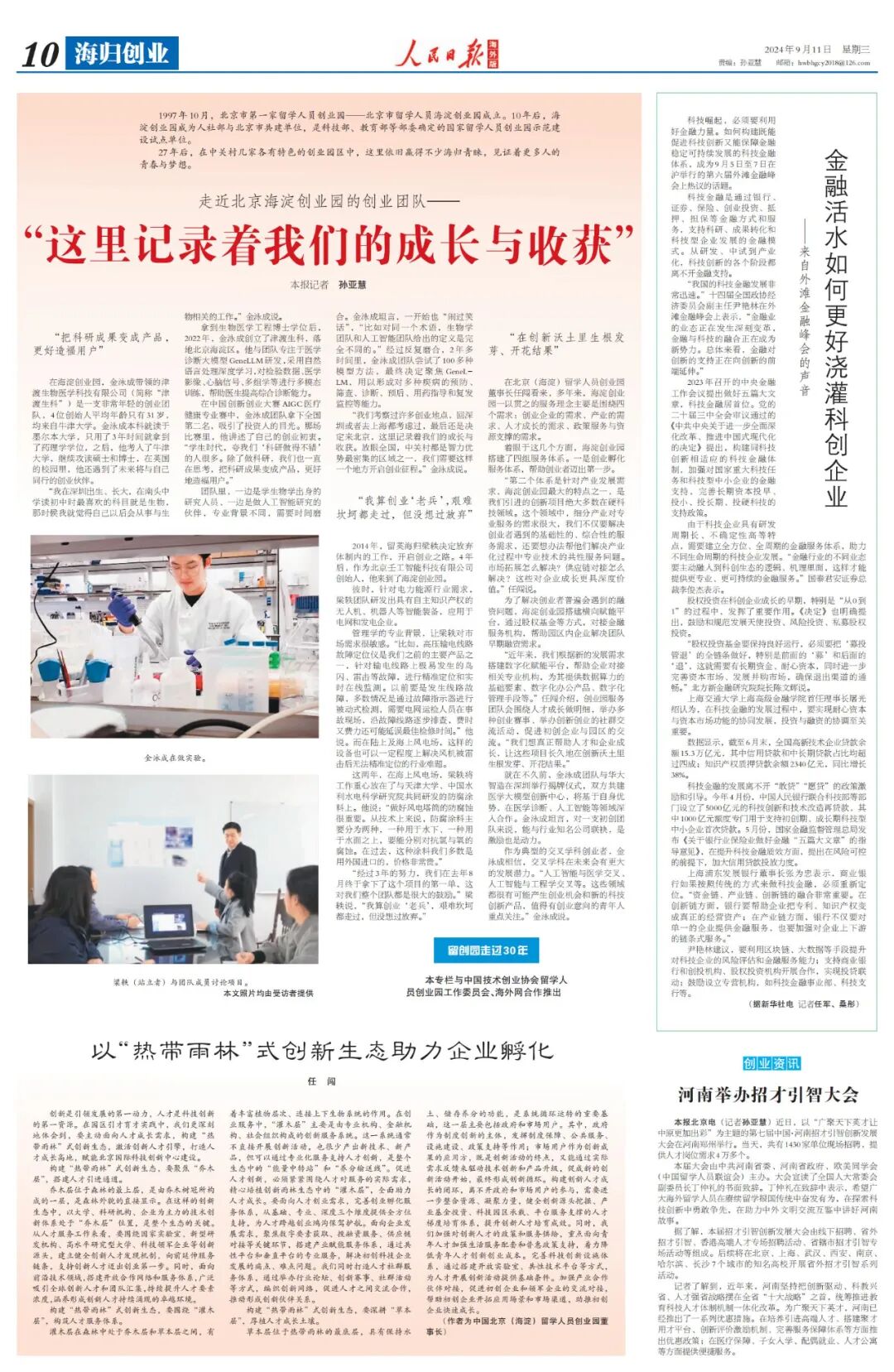
In October 1997, Beijing's first overseas returnee entrepreneurship park—Beijing Haidian Incubator for Overseas Returnees—was established. Ten years later, it became a joint venture between the Ministry of Human Resources and Social Security and the Beijing municipal government, designated as a national demonstration pilot unit for overseas returnee entrepreneurship parks by the Ministry of Science and Technology and the Ministry of Education.
27 years later, among several distinctive entrepreneurship parks in Zhongguancun, it still attracts many overseas returnees, witnessing more people's youth and dreams.
"Turning Research into Products to Better Benefit Users"
At Haidian Incubator, the team led by Jin Yongcheng at OxTium Technology is a very young startup team. The four founders have an average age of only 31, all from Oxford University. Jin Yongcheng earned his pharmacology degree from the University of Melbourne in just three years, then pursued his master's and PhD at Oxford University, where he met his future co-founders.
"I was born and raised in Shenzhen. In middle school at Nantou High School, my favorite subject was biology. Even then, I felt I would work in biology-related fields," Jin said.
After earning his PhD in Biomedical Engineering, Jin founded OxTium Technology in 2022, based in Beijing's Haidian District. His team focuses on developing the medical diagnostic large model GeneLLM, using natural language processing deep learning for multimodal training on lab data, medical imaging, cardiac and brain signals, and multi-omics, to help doctors improve comprehensive diagnostic capabilities.
At the China Innovation and Entrepreneurship Competition AIGC Medical Health Professional Competition, Jin's team won second place nationally, attracting investors' attention. In that competition, he shared his entrepreneurial motivation. "During our student days, many praised our research. Besides doing research, we also thought about turning research results into products to better benefit users."
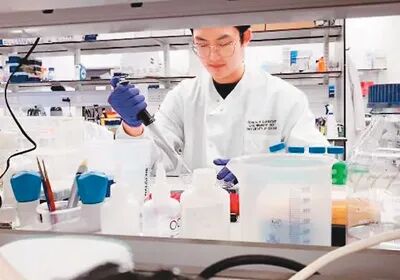
The team includes researchers from biology backgrounds and partners from AI research. Different professional backgrounds require time to integrate. Jin admitted that there were "funny misunderstandings" at first. "For example, the biology team and the AI team gave completely different definitions for the same term." After repeated磨合, over two years, Jin's team tried over 100 model approaches and finally decided to focus on GeneLLM, aiming to develop capabilities for prevention, screening, diagnosis, prognosis, medication guidance, and recurrence monitoring of various diseases.
"We considered many locations for our startup, including Shenzhen and Shanghai, but ultimately chose Beijing. This is where our growth and achievements are recorded. Nationwide, Zhongguancun is one of the most intellectually dense areas. We needed such a place to start our entrepreneurial journey," Jin said.
Not long ago, Jin's team and MGI held a unveiling ceremony in Shenzhen to jointly establish a Medical Large Model Innovation Center, leveraging their respective strengths for in-depth cooperation in medical diagnostics and AI. Jin acknowledged that for a startup team, partnering with a well-known industry company is both an encouragement and a motivation.
As a typical interdisciplinary entrepreneur, Jin believes interdisciplinary fields have greater development potential in the future. "Intersections of AI and medicine, AI and engineering, etc. These areas are likely to generate entrepreneurial opportunities and innovative technological products, worthy of attention from young people with entrepreneurial aspirations," Jin said.