
AI-Driven Bio-Fermentation
Intelligent Solutions
Powered by online spectral sensing, multimodal foundation models, and reinforcement learning—building a production-side digital twin factory. Achieve minute-level soft sensing of core parameters, adaptive feeding decisions, and early anomaly warnings to help biomanufacturers precisely reproduce golden batches.
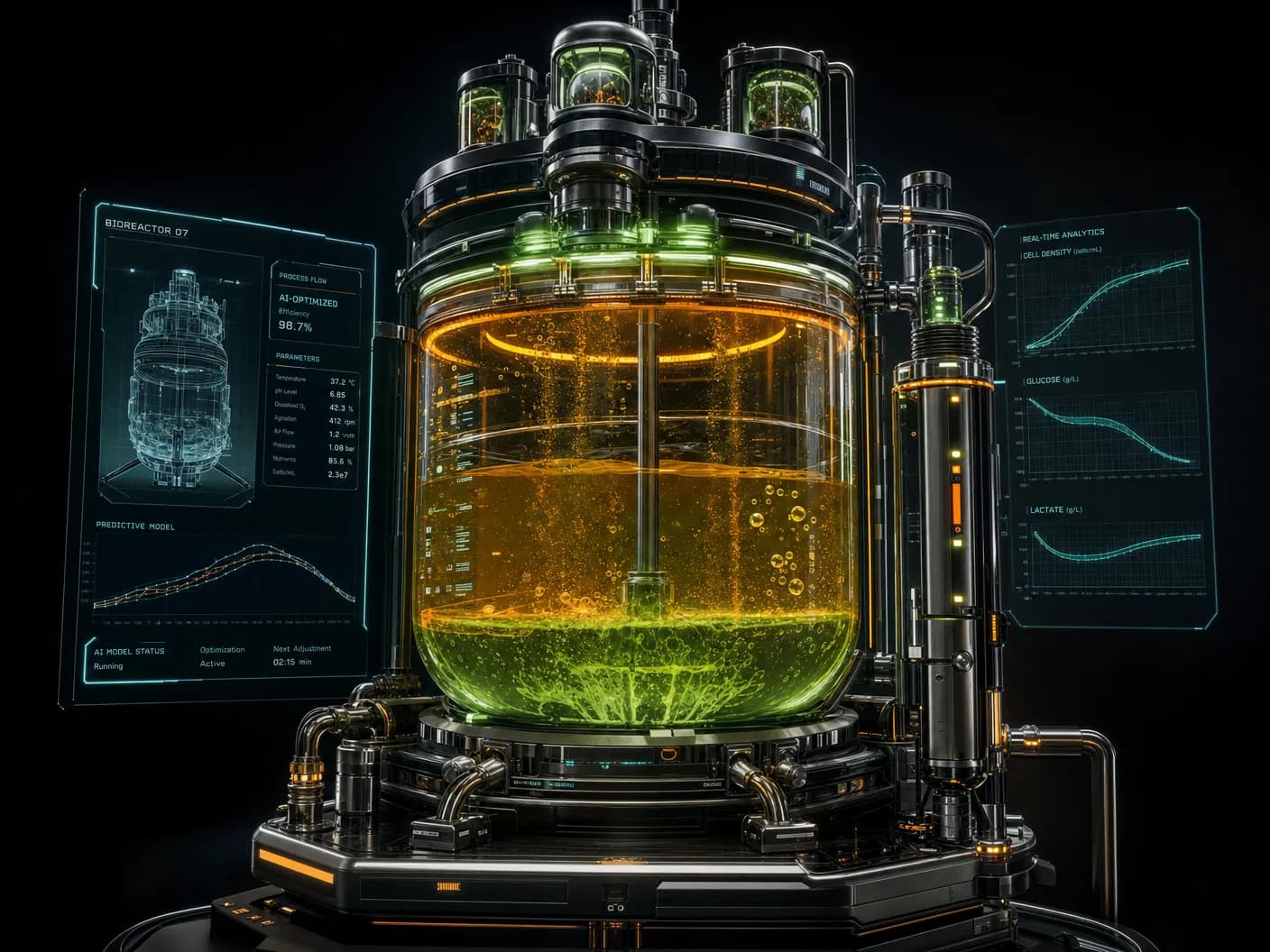
Integrated Bio-Fermentation Digital Twin Cockpit
Transform complex biochemical processes into transparent, predictable digital metrics—enabling full-process visibility from strain preparation to harvest and discharge.
1. Global Visibility: Environment & Equipment Integration
Aggregate environmental monitoring (temperature, humidity, dissolved oxygen, pH, etc.) and fermentation tank/instrument status on a single screen. Real-time dashboards help managers quickly locate anomalies.
2. Real-Time Monitoring & Process Optimization Loop
Continuously monitor stirring speed, aeration, feeding rate, and other key parameters based on online sensors and batch data streams. Built-in process models automatically analyze deviations and provide optimization recommendations.
3. Core Parameter Soft Sensing
Online estimation of cell density and potency from easily measured variables (DO, off-gas composition, fermentation time, etc.)—replacing traditional offline sampling with minute-level feedback for precise feeding and harvest decisions.
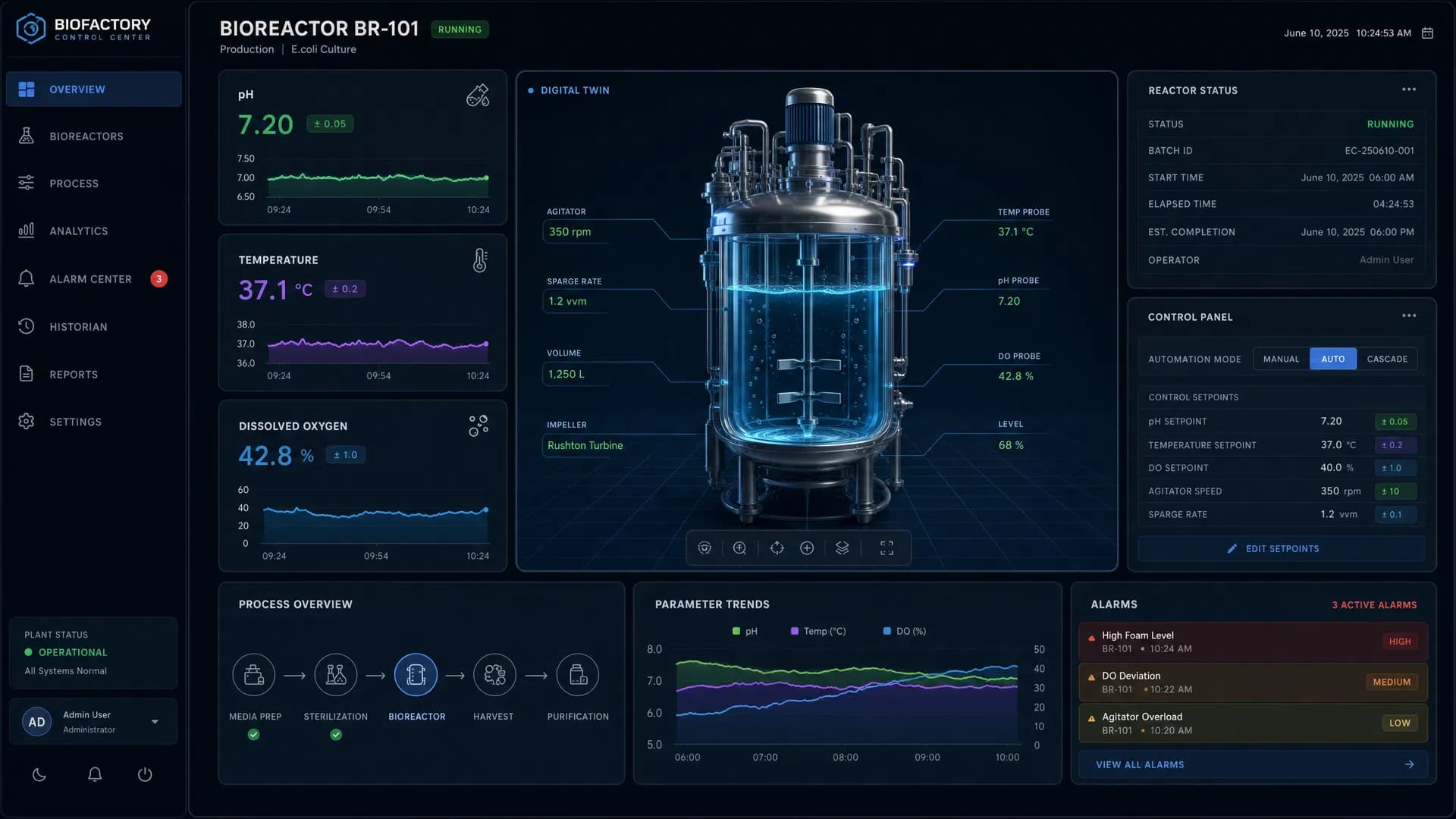
Unified Multi-Source Fermentation Data Integration
Break data silos by fusing automated collection, manual entry, and historical offline data to build a comprehensive AI analysis closed loop.
Automated Data Collection
Automatically collect real-time fermentation equipment data via DCS, online sensors, and process intervention—including temperature, pH, dissolved oxygen, and other key process parameters.
Manual Non-Automated Data Entry
Support manual entry of offline test data (total sugar, total nitrogen, residual sugar, viable cell count, etc.), process adjustment records, pre-harvest parameters, and seed fermentation data.
Historical & External Data Import
Support batch import of historical fermentation data, OCR scanning of paper batch records, Excel files, and other external data sources—connecting the full lifecycle of enterprise fermentation data.
Precision Fermentation Equipment & Sensor Monitoring
Full-cycle real-time monitoring of all fermentation tank groups and sensor health in the workshop—rapid anomaly alerts and complete closed-loop management from production to equipment maintenance.
AI-Driven Fermentation Process Intelligence
Integrating deep learning and reinforcement learning for precise prediction, autonomous feeding, and process decision-making.
RL-Based Closed-Loop Adaptive Feeding
Traditional feeding relies on empirical curves and struggles with raw material batch variation and environmental interference. OxTium builds PPO-based policy models that capture real-time states and automatically adjust feeding rate and type for true process autonomy.
AI-Assisted Peptide Fermentation: Process Optimization Case
BCP peptides are highly active and structurally refined, demanding extremely precise fermentation control. OxTium AI algorithms deeply intervene in the three-stage scale-up system for remarkable yield improvement and cost reduction.
E. coli Expression System Three-Stage Scale-Up
Peptide production uses E. coli expression through shake flask → 150L seed tank → 2000L main fermenter scale-up. Inducer is added when cell density reaches set values; cells are harvested by centrifugation after induction.
Significantly mitigating E. coli autolysis and peptide degradation risks with highly stable quality.
Seed Maturity Assessment & Timing Control
Fusing multi-dimensional inputs (OD, turbidity, gas consumption) with microscopy image analysis to automatically determine log-phase late stage, with optimal transfer timing controlled within ±5%.
Intelligent Feeding Stage Recommendations
AI predicts substrate consumption rate and cell requirements, automatically recommending optimal feeding timing and speed—avoiding C/N imbalance and reducing acetate byproduct accumulation by 30%.
Optimal Induction Window Prediction
E. coli peptide induction expression model trained on growth stage (OD, DO slope) and metabolic heat rate—induction timing prediction accuracy improved to 92%.
First-Derivative Fermentation Endpoint
Target peptide yield prediction model combined with real-time first-derivative analysis to detect yield plateau—precise endpoint control preventing cell autolysis and degradation.
Physical Factory 1:1 Virtual Replica: Digital Twin
During industrial fermentation, build a 1:1 virtual replica of the physical fermentation factory—deeply optimizing fermentation processes through real-time monitoring and algorithmic feedback.
Dynamic Environment Simulation
Real-time simulation of how raw materials, temperature, and pressure affect growth and product synthesis—supporting advance decision-making.
Core Parameter Soft Sensing
Real-time, high-precision estimation of cell density, potency, and other core variables in the digital twin via deep neural networks.
Metabolic Bottleneck & Fault Detection
Visual monitoring of enzyme utilization to clear production bottlenecks, with early contamination warnings to avoid batch loss.
Precise Golden Batch Reproduction
Based on simulation results, use reinforcement learning to adaptively adjust feeding and stirring to reproduce the highest-yield control curve.
OxTium Solution Implementation & Deployment Path
From data collection and model training to secure on-premise appliance deployment—providing comprehensive compliance and high-privacy implementation assurance.
Data Collection & Preprocessing
Enterprises only need to provide 10-20 batches of historical fermentation data (including offline assays, external environment, etc.) to establish data standards.
Model Building & Optimization
Pre-train dedicated time-series prediction and decision models on sample data, with simulation validation and hyperparameter optimization.
On-Premise Deployment & Integration
Integrated hardware-software deployment on enterprise intranet (appliance/local server)—data never leaves the intranet, meeting strict privacy compliance.
Foundation Model Instruction Fine-Tuning
Introduce on-site process expert annotations via RLHF and other methods to strengthen automatic draw and seed judgment capabilities.
Go-Live & Continuous Optimization
System enters trial operation, continuously collecting field feedback for seamless online OTA algorithm upgrades and rolling optimization.
Data Never Leaves Intranet, Physical Security Isolation
OxTium deeply understands that biological assets and process formulas are core enterprise secrets. We provide full hardware-software appliance on-premise deployment, integrating with intranet DCS systems and database policies—no public internet connection required for physical-level data protection.
Start Your AI Bio-Fermentation Intelligence Journey
Contact us to learn how AI helps your biomanufacturing business reduce costs and improve efficiency
Request Demo