Reaching the vast and subtle, seizing the moment with momentum.
Recently, Shenzhen OxTium Biomedical Technology Co., Ltd. (hereinafter "OxTium Technology") officially completed its Series A financing round, led by GTJA Investment. The nearly 100 million RMB funds will be primarily used to deepen the development of Physics-AI underlying architecture, iterate and upgrade the BioFord Agent embodied autonomous research platform, and expand global market presence.
BioFord Agent: From "Intelligence on Paper" to the Physical World
① BioFord Agent: Core Carrier of the Embodied Autonomous Research Platform
BioFord Agent is a one-stop AI research platform built by OxTium Technology. It connects downward to the physical layer of the laboratory and upward to the cognitive layer of scientists, bridging the gap between reasoning and execution through Physical-AI, enabling a paradigm shift from "dry-wet loop" to "embodied intelligent discovery."
At the cognitive layer, BioFord Agent consists of a collaborative network of literature retrieval agents, experimental design agents, scientific agents, and data analysis agents. They respectively handle knowledge synthesis, protocol generation, mechanism modeling, and data attribution, simulating the thinking division of top research teams, integrating fragmented workflows into automated pipelines, greatly improving research efficiency and subverting traditional research paradigms.
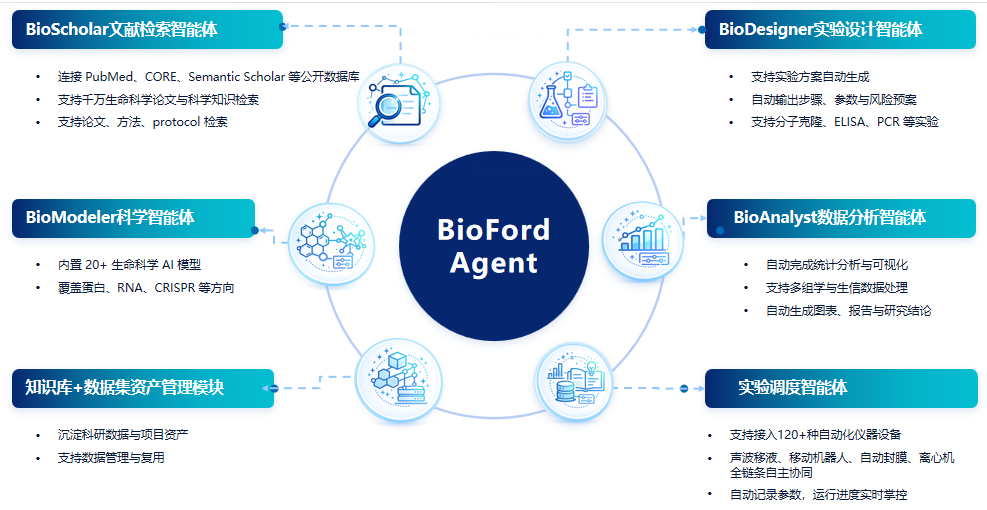
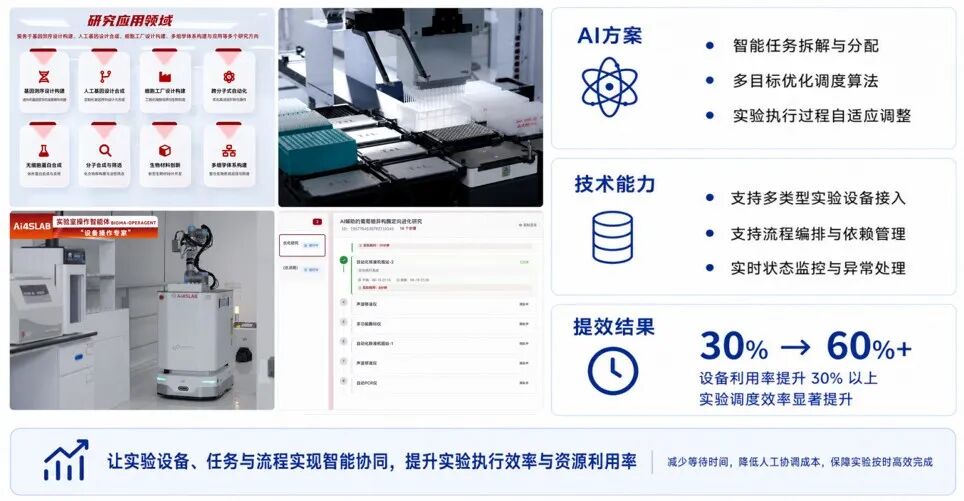
At the physical layer of the laboratory, the experimental scheduling agent automatically generates experimental work orders based on Physical-AI reasoning, specifying liquid volumes, temperature gradients, and time windows, with real-time tracking of the entire sample lifecycle, all recorded on the blockchain.
Meanwhile, the agent acts like a "traffic commander" in the lab, dynamically optimizing task queues based on equipment availability, consumable inventory, and personnel schedules, enabling automatic equipment takeover and 7×24 uninterrupted experiments. During experiments, it continuously compares predicted values with actual measurements, triggering system alarms and automatically initiating calibration or adjusting subsequent parameters, truly enabling the Design→Build→Test→Learn cycle.
"During R&D, we gradually realized that AI for BioScience is not simply about stacking models and data. For those conducting experiments, the ultimate challenge remains: after computation, they still can't execute; after execution, the results are still wrong."
OxTium Technology founder & CEO Jin Yongcheng stated that BioFord Agent currently covers hardware such as high-throughput sequencing equipment, liquid handling workstations, biochemical analyzers (PCR/microplate readers), and mass spectrometry instruments (LC-MS/TOF), scheduling equipment from different manufacturers via protocols for efficient and precise experimental operations.
Through the deployment of BioFord Agent's five intelligent agents at multiple renowned universities and research institutes, OxTium Technology continues to refine the closed-loop capability from digital hypotheses to physical validation, freeing scientists from tedious operations and allowing them to return to the essence of innovation.
② GeneLLM + BioFord: Dual-Engine Architecture of AI Computing and Physical Experiments
OxTium Technology's core competitiveness stems from the dual-engine architecture of "large model cognitive engine + automated experimental platform." GeneLLM provides data understanding and hypothesis generation capabilities surpassing human scientists, while BioFord Agent ensures every hypothesis is efficiently and accurately validated in the physical world. Together, they form a complete closed loop for embodied autonomous research.
GeneLLM is the world's first multi-omics large model pre-trained on raw data. Unlike mainstream models trained on species genomic data, GeneLLM directly uses individual raw sequencing data—RNA-seq, proteomics, metabolomics, and other massive raw omics data—as pre-training input, outputting disease characterization correlation analysis end-to-end, avoiding error accumulation from hierarchical modeling. The current version has achieved 1.5 billion parameters and 3.5 trillion base pairs of sequence model pre-training.
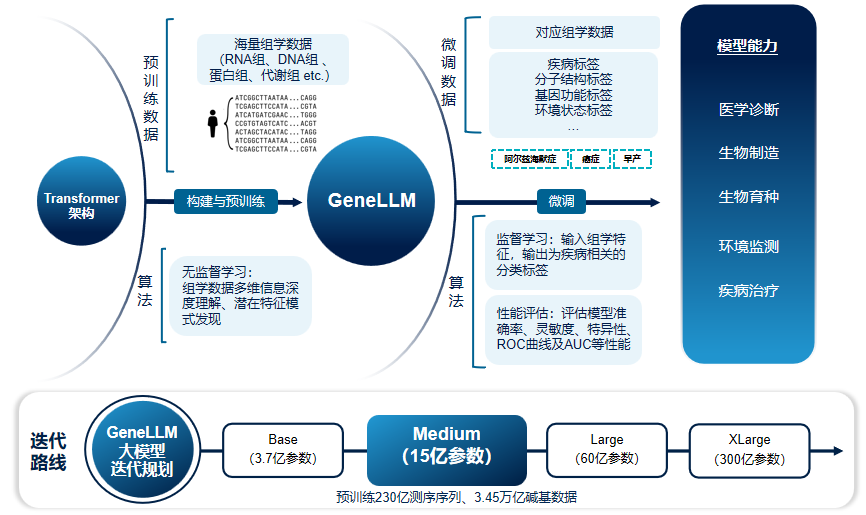
At the algorithmic level, GeneLLM employs unsupervised learning for deep multi-dimensional understanding of omics data and discovery of latent feature patterns; after pre-training, it undergoes supervised fine-tuning with corresponding omics data, disease labels, molecular structure labels, etc., with performance evaluation using multi-dimensional metrics such as accuracy, sensitivity, specificity, and AUC. The next-generation XLarge version is expected to achieve 300 billion parameter model pre-training, continuously expanding the technological moat.
Based on GeneLLM, BioFord Agent comes with a built-in library of 20+ biological models, supports local or cloud deployment, and enables adaptation and integration across domain tasks. The platform simultaneously offers three delivery forms: algorithm R&D, cloud platform services, and inference all-in-one machines, meeting the needs of different user scales. On the hardware side, OxTium's inference all-in-one machines feature high computing density, high security compliance, high general-purpose framework, low procurement cost, low usage threshold, and low operation and maintenance energy consumption, paired with NVIDIA and domestic computing solutions to meet local deployment needs of various customers.
③ From "Dry-Wet Loop" to "Embodied Intelligent Discovery": Three Paradigm Shifts in Research
OxTium Technology's development path clearly outlines three paradigm shifts in AI for BioScience from auxiliary tool to research infrastructure: from "AI-assisted analysis" to "dry-wet loop," and then to "embodied scientific discovery." The work pattern also evolves from "human + AI computing" to "AI computing + automated experiments," with human-machine collaborative validation, ultimately achieving "Physical-AI + embodied intelligence."
OxTium Technology has taken the lead into the third stage. BioFord Agent is not just a scheduling system for automated experiments but an "embodied research agent" with autonomous hypothesis-validation-iteration capabilities.
In medical diagnostics, OxTium Technology's risk prediction accuracy has reached world-leading levels. Based on raw cfRNA sequence modeling, GeneLLM demonstrates significantly superior diagnostic accuracy compared to competitors in multiple disease screening and risk prediction. The AUC for 5-year Alzheimer's disease risk prediction reaches 0.91; the AUC for preterm birth prediction in pregnant women has improved to 0.89, achieving a qualitative leap. The company has established deep collaborations with authoritative institutions including the Chinese Academy of Sciences Peking Union Medical College, BGI, and Shenzhen Luohu District People's Hospital.
In the biomanufacturing field, OxTium's AI-assisted gene editing design automatically generates sgRNA libraries compatible with the CRISPR-Cas9 system, successfully achieving domestic substitution of advanced reagents, reducing costs by 97% compared to similar imported reagents. Meanwhile, the AI4S LAB, in collaboration with Baidu Intelligent Cloud, has been deployed in domestic universities, becoming the world's first AI4S native closed-loop life science laboratory. Compared to manual operations, the automated platform significantly improves experimental efficiency—E. coli vector construction throughput increased 83-fold, protein expression detection increased 5.6-fold, and tagged protein purification increased 6.7-fold.
Furthermore, OxTium Technology's products demonstrate strong generalization capabilities, having signed contracts with over 30 leading institutions including BGI, Union Oncology, Shanghai East Hospital, and the Chinese Academy of Environmental Sciences. The company has taken the lead in expanding overseas markets, continuously delivering tumor combination target analysis results, with an increasing proportion of overseas business, showcasing robust commercialization capabilities.
Continuous Funding: Jointly Building Intelligent Infrastructure for Bioscience
GTJA Investment, the lead investor in this round, was founded in 2001 and is one of the few domestic institutions that has focused exclusively on the healthcare sector for 24 years. GTJA Investment, with strategic equity investments as its core, covers all stages from angel to M&A, managing over 23 billion RMB in assets. It has helped 30 medical companies, including Mindray Medical, United Imaging Healthcare, and Akeso Biopharma, successfully go public, with operational centers in Shenzhen, Shanghai, Beijing, and Hong Kong.
GTJA Investment Managing Partner Teng Yuhang believes that AI life sciences are triggering strategic deployments globally.
"OxTium Technology, as a young but creative company, has built the BioFord one-stop bioscience research platform, transforming fundamental life science research into a subscribable and scalable 'computing + experiment' infrastructure. We are honored to lead this round and look forward to the company achieving more breakthroughs in the AI4S field."
In 2025, OxTium Technology has successively received multiple rounds of investment from institutions including Sequoia Capital Seed Fund, CDF Capital, and Nanshan Strategic Emerging Industry Investment.
As a global leader in AI for BioScience, OxTium Technology is led by four Oxford University alumni and is a National High-Tech Enterprise and a national "Open Competition" unit. The company consistently adheres to technological depth, committed to breaking down barriers between basic research and industrial application.
Jin Yongcheng stated that partnering with GTJA Investment this time will continue to focus on underlying technologies, building verifiable, reusable, and scalable intelligent infrastructure, jointly promoting bioscience into a new AI era.