Uniting bio-intelligence manufacturing, jointly opening a new chapter for the industry.
From September 21 to 23, the 17th International Biofermentation Expo Series and the Bio-Manufacturing Intelligent Equipment and Digital Bioengineering Forum concluded successfully at the Hangzhou International Expo Center.
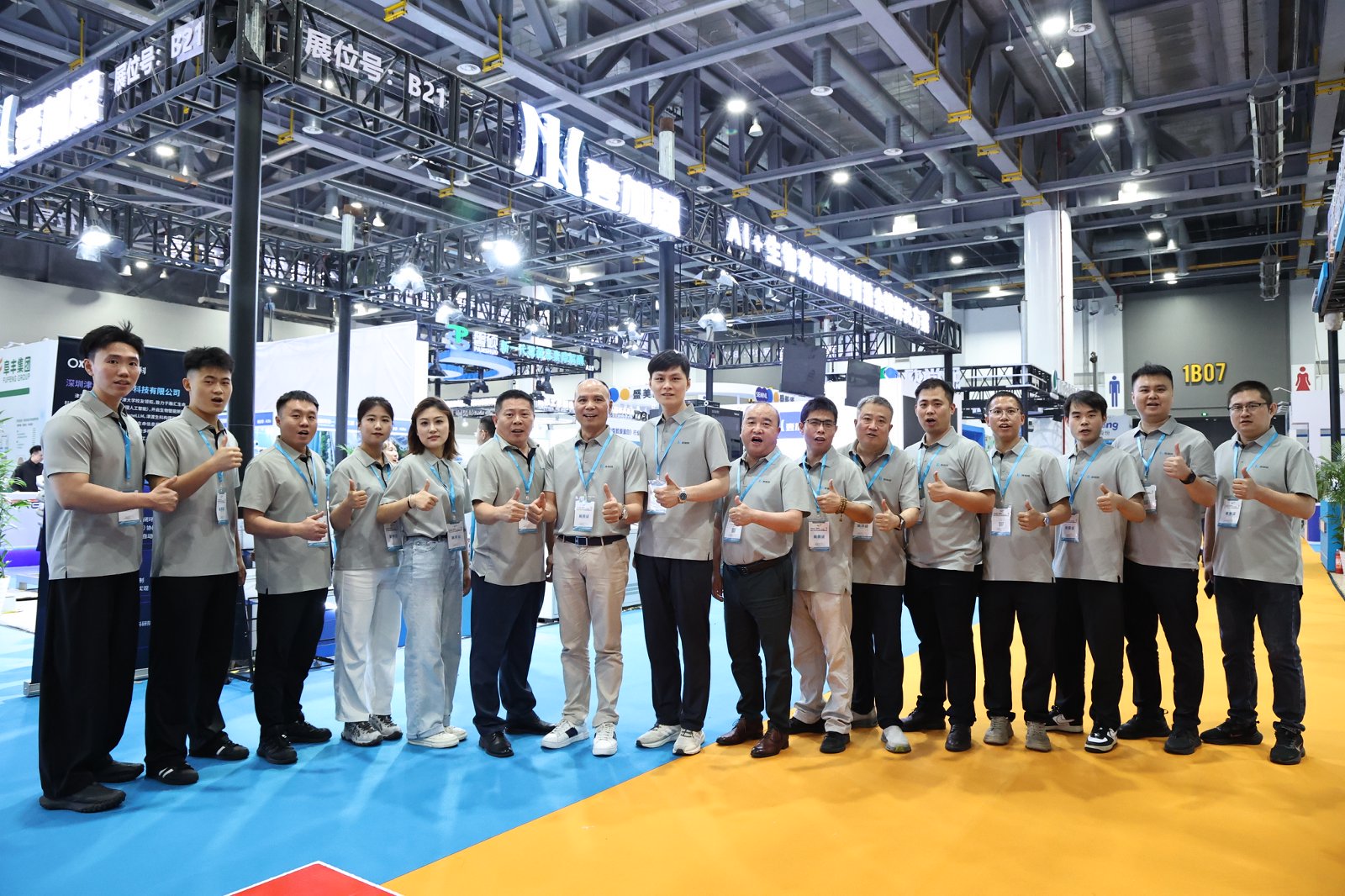
OxTium Technology joined forces with Hebei Yijiaen Intelligent Technology Co., Ltd. (hereinafter referred to as Yijiaen) at Booth B21 in Hall 1B, and delivered a keynote report on AI for fermentation, discussing cost reduction, efficiency gains, and commercialization with industry chain partners.
Keynote Report
From Manual Experience to Industrial-Grade Closed-Loop Control
At the forum, Deng Siwei, Co-founder & CTO of OxTium Technology and Chief Scientist of the Yijiaen × OxTium Technology Joint R&D Center, delivered a keynote speech titled "Cutting Costs, Boosting Efficiency, Empowering the Full Chain: From Manual Experience to Industrial-Grade Closed-Loop Control," sharing insights on fermentation industry pain points, AI-empowered fermentation technology practices, and industrial-scale deployment cases. The venue was packed.
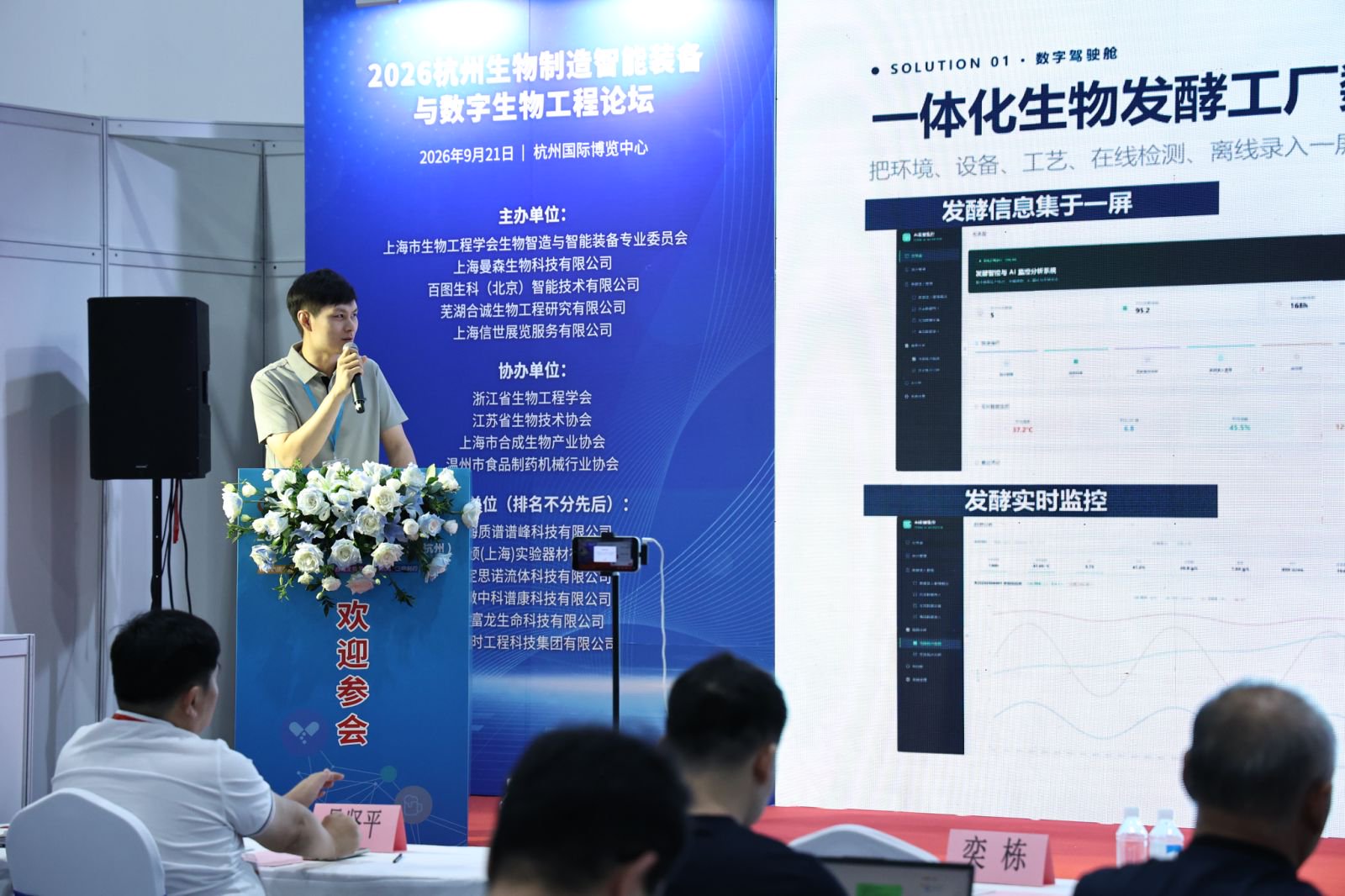
Deng Siwei pointed out that the upgrading of fermentation plants follows an inherent sequence — first digitalization, then automation, and ultimately intelligence. These three stages are not steps that can be skipped, but progressive phases, and OxTium Technology designs tailored solutions for plants at different stages accordingly.
Digitalization stage: eliminating information silos. Many plants still rely on engineers manually filling out reports, with data scattered across different shifts and systems, making batch comparison and problem tracing difficult. OxTium first connects equipment and system interfaces, unifies data standards and time-series baselines, establishes electronic batch records and visualization dashboards, and consolidates the production process into trustworthy, traceable data assets.
Automation stage: making key states continuously visible. Many plants still rely on manual operations for critical tasks — cell density, titer, and metabolic byproducts depend on offline testing with feedback delays exceeding 2 hours; feeding and bleeding are judged by experience; by the time anomalies are detected, losses have already occurred, and successful batch experiences are hard to replicate. OxTium uses Raman spectroscopy combined with online sensing equipment to build soft-sensor models, transforming key indicators from "offline sampling" to "minute-level continuous observation," providing the data prerequisite for AI to make further judgments.
Intelligence stage: letting AI participate in decision-making. Current fermentation is still fundamentally a process highly dependent on manual experience with key states not continuously observable. OxTium Technology's AI digital-intelligence platform builds process models around "state—action—response—result," using time-series models to drive automatic bleeding, automatic feeding, anomaly prediction, and endpoint prediction, and can seamlessly connect with plant DCS to dispatch decisions to the execution layer. OxTium enables AI to move from "seeing data" to "making decisions," turning the experience of excellent batches from "a certain engineer knows how to do it" into "this production line knows how to do it."
From "Invisible" to "Controllable"
AI Truly Delivers Three Major Production Values
For fermentation plants, what AI ultimately needs to answer is not "is there more data," but three questions:
Can we produce a little more? Can we spend a little less? Can we make every batch more stable?
Through soft sensing, dynamic feeding, anomaly alerts, and process prediction, OxTium Technology further translates AI capabilities into three categories of industrial value:
Quality improvement — increasing product concentration, yield, and expression levels to unlock existing capacity;
Cost reduction — reducing over-feeding, under-feeding, ineffective waiting, and abnormal scrapping to lower unit production costs;
Stability — consolidating excellent batch experiences, reducing batch fluctuations, and gradually turning "occasionally doing well" into "consistently doing well."
Ultimately, AI moves from being a technical tool to truly entering production and business results.
Deployment Validation
AI Projects Validate Cost Reduction and Efficiency Gains
Currently, the platform has been validated in multiple industrial-scale projects.
AI + Dual-Spectroscopy Sensing Intelligent Continuous Fermentation:
Product concentration +33%, real-time monitoring delay <1 minute (previously >2 hours), byproduct concentration −10%, unit production cost −18.4%.
BCP Peptide Three-Stage Coordinated Control:
Bleeding wait time reduced by 10%±5%, average yield +8%, acetate accumulation −30%, expression level +15%, monthly abnormal scrapping reduced by 2 batches.
OxTium Technology adapts the same "perception—prediction—decision" loop to different manufacturers; only the adaptation layer changes. We first deeply understand the manufacturer's production line status and process requirements, then adjust models and configurations accordingly to form personalized, customized solutions.
This framework has initially undergone cross-strain validation: from bulk antibiotics and macrolides to CHO cell culture and E. coli recombinant expression, covering both microbial fermentation and animal cell culture systems.
The key is that when switching strains, the underlying perception and decision engines need not be rebuilt — only the process knowledge layer needs adaptation — namely, the metabolic characteristics, key state variables, and feeding and harvesting strategies of different strains.
Safe Deployment
Letting AI Gradually Enter the Production Floor
Considering the high requirements for stability and safety on the production floor, OxTium Technology does not let AI take over control all at once, but adopts a "observe—recommend—autonomous" three-stage progressive path, with independent exit criteria set at each step, allowing AI control authority to be gradually opened up as validation results are confirmed.
Observe: Complete data collection and alignment, make key states visible online, and let the system first "understand" the site.
Recommend: Split into two steps — first, prediction, using soft-sensor and other models to accurately output parameters such as cell density and titer that originally depended on offline testing; on this basis, make judgments and recommendations, providing timing and quantity recommendations for operations such as feeding and bleeding, executed after manual confirmation.
Autonomous: Only after both prediction accuracy and recommendation adoption rate pass exit validation, connect with DCS to enter the decision closed loop for functions such as automatic feeding and automatic bleeding.
The design principle of this path is: prove trustworthiness first, then gradually delegate authority. Each step has clear quantitative exit thresholds and rollback mechanisms, ensuring that while improving intelligence levels, production safety and compliance red lines are not crossed.
At the same time, we support localized private deployment, ensuring data and process knowledge security through permission management, full-chain auditing, and other mechanisms.
Open Cooperation
Jointly Promoting Commercialization of Fermentation Projects
Bio-manufacturing is accelerating toward intelligence and sustainability. OxTium Technology hopes to join hands with fermentation plants, synthetic biology, and bio-manufacturing enterprises, starting from a specific production scenario, validating AI value with quantifiable results, and then gradually achieving large-scale replication.
Currently open cooperation directions include:
Digitalization: Integrated digital platform connecting data collection, storage, and traceability, establishing a unified time-series data foundation; providing Raman spectroscopy and online sensing equipment deployment, paired with soft-sensor models, to achieve continuous observation of key parameters;
Automation: Coordinated control of automatic feeding, automatic bleeding equipment, and continuous sterilization equipment, as well as integration and adaptation with domestic DCS;
Intelligence: Deployment and development of localized models, implementing intelligent functions such as anomaly prediction and endpoint prediction, supporting private deployment to ensure data security.
Cooperation methods are flexible: you can start with a single-point scenario for pilot validation, or advance holistically along the "digitalization—automation—intelligence" path.
From laboratory to factory, from data to decisions, from single-point optimization to closed-loop control, OxTium Technology looks forward to working with industry partners to complete the commercialization loop of fermentation projects, truly transforming AI into higher-yield, lower-cost, and more stable productivity.