
OxTium Technology (OxTium) and HwaGen Pharma have entered into a partnership to jointly build an AI lab platform for intelligent small-molecule drug discovery. The two parties will combine HwaGen Pharma's expertise in medicinal chemistry, process design and development, experimental systems, and R&D data with OxTium's agent technology, R&D platform development, and robotics integration capabilities, connecting computational analysis, protocol generation, task approval, experiment execution, and results analysis into a single R&D workflow.
Medicinal Chemistry × AI Capabilities
Turning Research Protocols into Experimental Tasks
Early-stage small-molecule drug discovery requires repeated iteration across process design, synthesis, activity testing, and lead compound optimization. Computational tools can help screen candidate protocols, and automated equipment can handle some repetitive operations, but bridging the gap from computational results to executable experimental tasks—and then to traceable experimental records—still requires researchers to coordinate across different systems and devices.
This collaboration will start from HwaGen Pharma's actual R&D scenarios, enabling AI, experimental equipment, and researchers to collaborate within a single workflow.

Shenzhen HwaGen Pharma Technology Co., Ltd. is a well-known local brand in the Guangdong-Hong Kong-Macao Greater Bay Area specializing in small-molecule contract research and manufacturing, providing global innovative pharmaceutical companies with one-stop process development and manufacturing services spanning from drug discovery through clinical research to commercialization.
As a National High-Tech Enterprise, HwaGen Pharma is deeply involved in and supports global innovative drug R&D through core technologies including internationally leading small-molecule CMC research, asymmetric catalysis, continuous flow process engineering, and AI plus automation, advancing innovative drugs from lab-scale and pilot-scale scale-up to green, efficient industrialization and regulatory filing. Its wholly owned subsidiary, Guangdong Raffles Pharmaceutical Technology Co., Ltd., operates a 28,000-square-meter high-end API GMP facility in the Huizhou Daya Bay Petrochemical Zone, offering diversified services to meet customers' varying needs.
This collaboration will combine its proprietary AI molecular retrosynthesis model DeepSynth with the experimental systems and data developed through early-stage molecular design, lead compound optimization, and structure-activity relationship research. OxTium Technology will leverage the multi-omics large model GeneLLM and agent technology to advance platform development, software systems, and experimental equipment integration.

The platform is planned to comprise a unified R&D platform, core agents, a robotic collaborative execution system, and a standardized data foundation. The unified R&D platform will handle project management, task creation, experiment approval, equipment status monitoring, and results reporting.
The agents will respectively handle literature retrieval and target evidence assessment, virtual computation, experimental protocol generation, automated experiment scheduling, and data analysis. The platform plans to integrate DeepSynth to assist researchers in evaluating candidate synthetic routes for molecules. The protocol generation agent will organize protocols into structured tasks for researcher review and subsequent scheduling.
Human-Machine Collaboration as a Principle
End-to-End Intelligent Upgrade
Researchers will be responsible for scientific judgment and critical operations, while robots and automated equipment execute approved tasks within authorized scope. Steps involving critical experimental condition adjustments, hazardous chemical operations, and key target conclusions will be confirmed by researchers. For existing equipment that does not yet have open interfaces, the platform will adopt semi-automated handoff or manual confirmation to integrate into the workflow, arranging the scope of automation based on actual equipment conditions.
Dr. Jin Yongcheng, Founder and CEO of OxTium Technology, stated:
"We want AI-generated protocols to be reviewable, robot-executed tasks to be traceable, and every experimental result to be linked to its corresponding samples and operational records. Only by running a real R&D workflow end-to-end can we determine which steps are suitable for automation and where the platform can be applied next."
Dr. Zhou Zhangtao, CTO of HwaGen Pharma, stated:
"For a medicinal chemistry team, the value of a computational recommendation depends on whether it can be translated into an executable experiment and whether the experimental results can help us decide what to do next. We want to bring HwaGen Pharma's experience in process design, process development, and synthesis into OxTium's platform, giving researchers more time to judge which molecules are worth pursuing and which routes are worth optimizing."
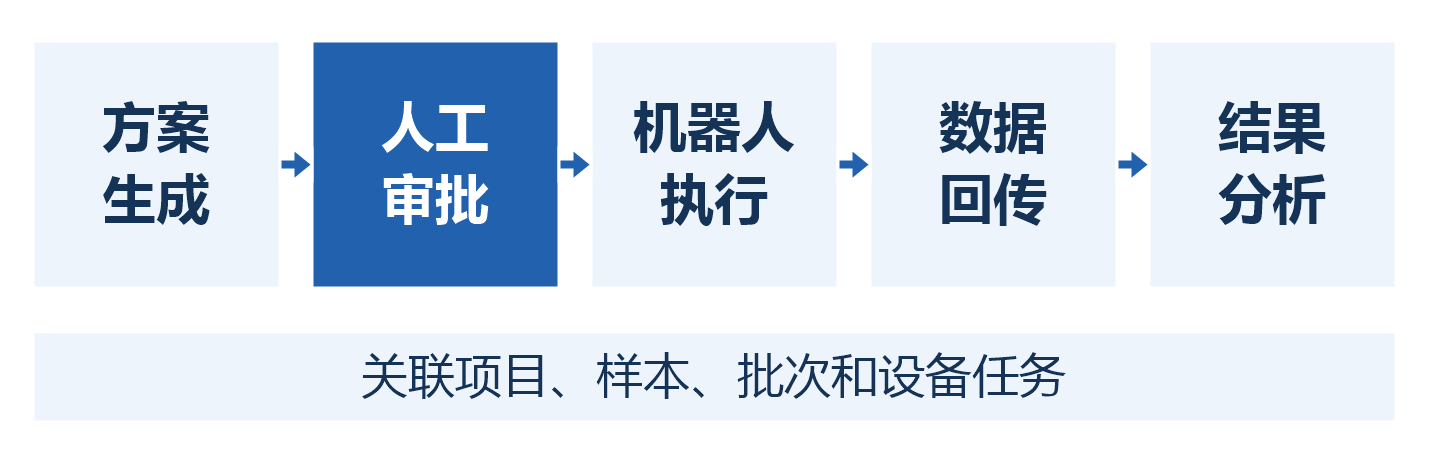
The platform covers protocol generation, task approval, robotic execution, equipment data feedback, and results analysis, establishing associations among projects, samples, batches, and equipment tasks so that researchers viewing results can trace experimental rationale, material records, and execution processes, providing a basis for subsequently expanding equipment integration and R&D scenarios.