On January 8-9, 2026, the 4th China Synthetic Biology and Biomanufacturing Conference (SynBioChina) was held at Shenzhen Weiguang Life Science Park. As an industry event gathering over a thousand elites from academia and industry, the conference focused on the frontiers of synthetic biology technology and industrial transformation, with the "AI Biomanufacturing Session" becoming the highlight.
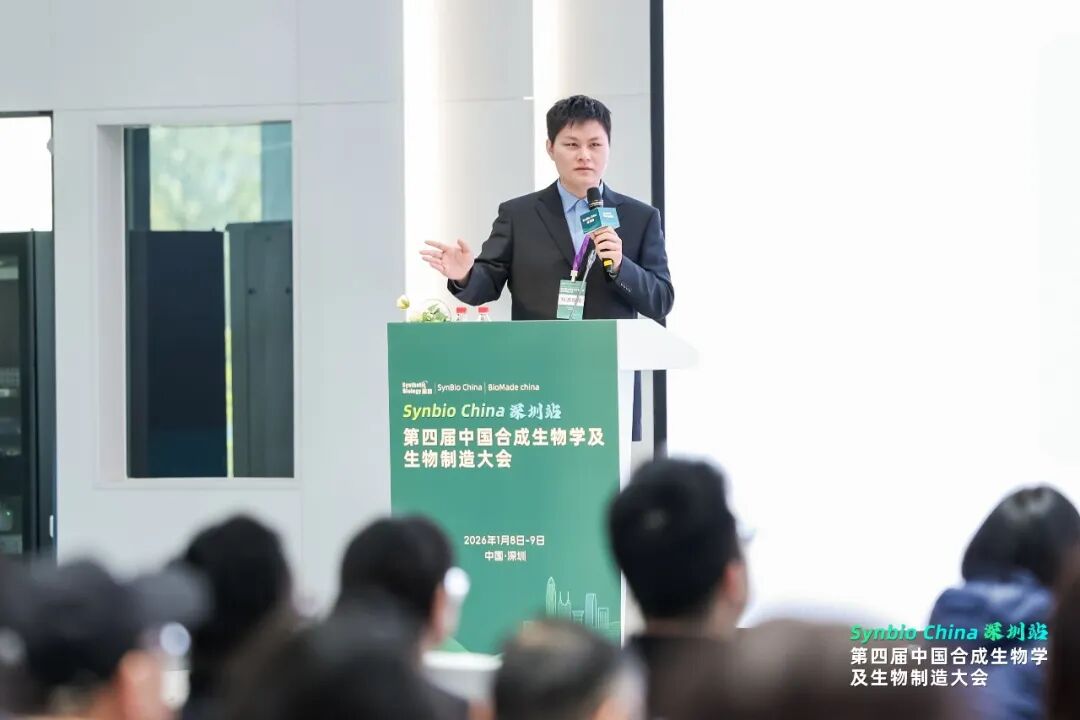
Dr. Deng Siwei, Co-founder & CTO of OxTium Technology, was invited to deliver a keynote speech, deeply analyzing the full-chain digital-intelligent closed-loop solution of AI-empowered biomanufacturing, sparking attention and discussion among attendees.
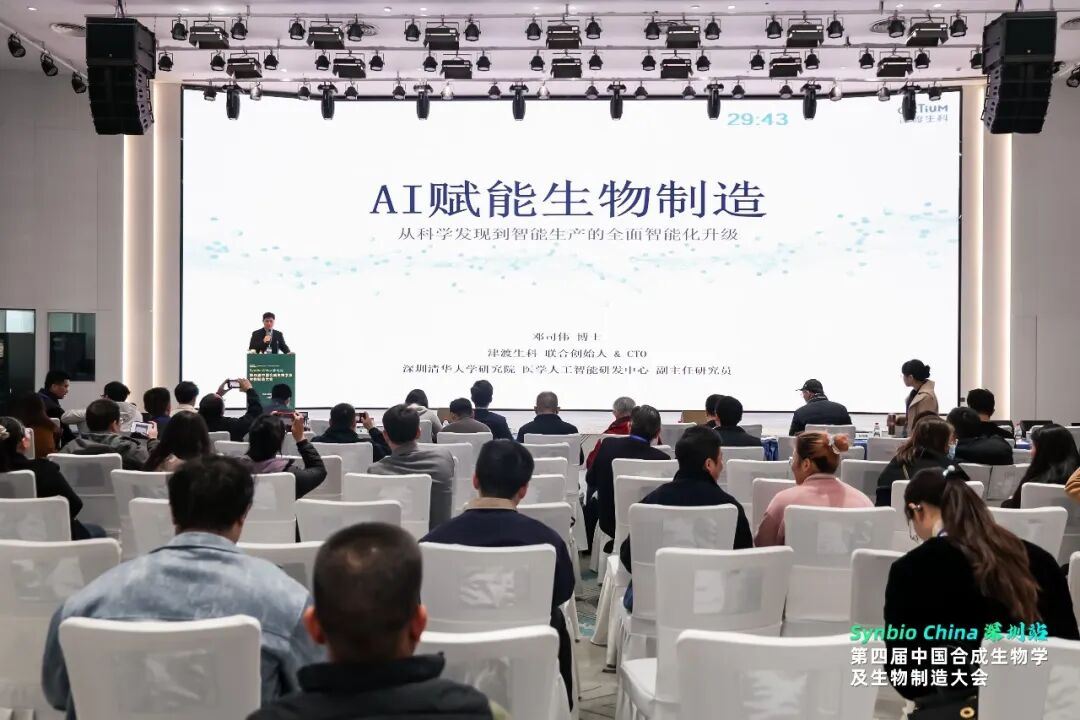
In his speech, Dr. Deng Siwei proposed that AI is evolving from a supporting tool into a "digital nervous system" for biomanufacturing, building an intelligent system integrating R&D, experimentation, and production.
In the R&D phase, addressing industry pain points such as literature explosion and high barriers to model application, retrieval-augmented generation (RAG) technology integrates public databases like PubMed and KEGG with the team's private knowledge base to achieve high-precision knowledge-related searches. The AI model matrix covering multiple dimensions such as proteins, DNA, and metabolites can already perform core tasks like antibody sequence completion, gene editing prediction, and molecular generation design, providing solid support for scientific decision-making.
Even more noteworthy is the innovative "scientific agent orchestration" model, which automatically schedules heterogeneous model chains through natural language interaction, freeing researchers from tedious engineering tasks like environment deployment and data alignment, allowing them to focus on the essence of scientific problems.
In the experimental validation phase, the AI-driven autonomous laboratory closed-loop system became a highlight.
The AI solution starts from hypothesis generation from the knowledge base, goes through intelligent experimental process design, autonomous hardware execution, and in-depth data analysis, and finally automatically writes academic reports via a large language model, achieving full-process automation from hypothesis to results. By accurately converting experimental instructions, completing logical chains, and adding safety verification layers, it effectively resolves the ambiguity and risks of traditional experiments, significantly improving experimental reproducibility and safety.
OxTium Technology's self-developed BioFord Agent platform can directly output complete experimental plans that meet statistical standards, and compile them into instruction sets recognizable by robots, adapting to high-throughput automated laboratory needs.
On the production and manufacturing side, OxTium Technology has built a fermentation full-scenario data integration architecture that merges multi-source data from DCS systems, online sensors, and laboratory tests. Through time-series models, it achieves core functions such as titer prediction, anomaly warning, endpoint determination, and seed maturity assessment.
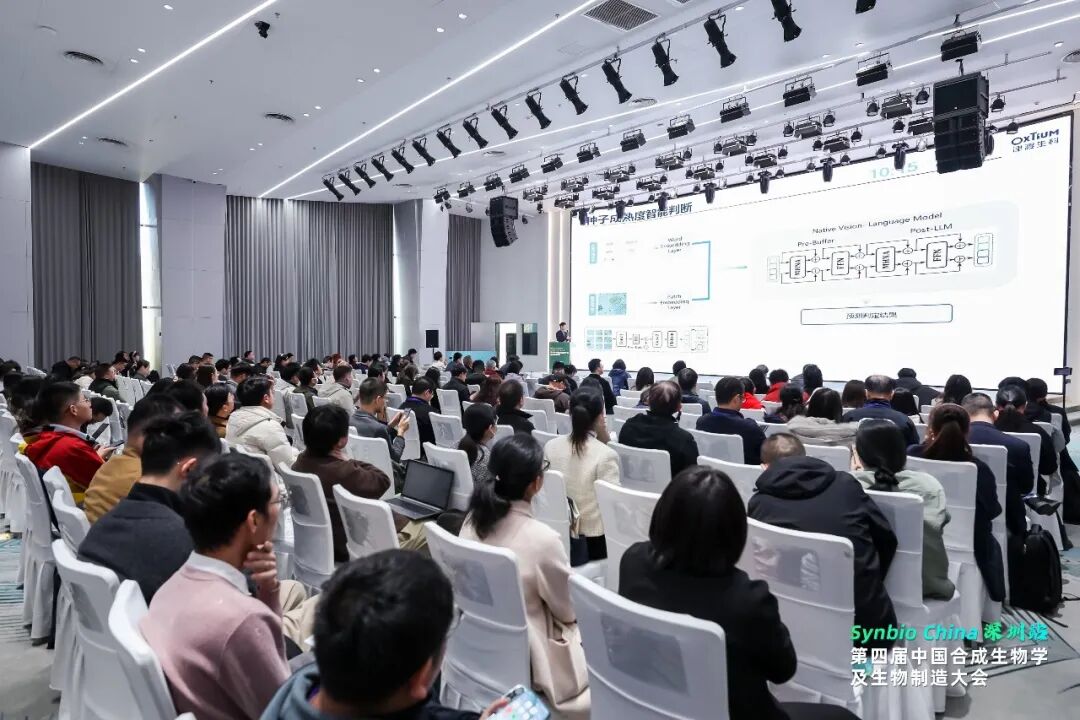
During the speech, Dr. Deng Siwei also shared multiple practical cases, demonstrating the powerful capabilities and significant effects of "AI + biomanufacturing."
"The deep integration of AI and synthetic biology is breaking the industrial bottlenecks caused by biological complexity," said Dr. Deng Siwei. OxTium Technology hopes that through full-chain digital-intelligent solutions, the standardization, scaling, and intelligence of biomanufacturing will become the industry norm, fostering new productive forces in the field of synthetic biology.
After the speech, many attendees engaged in in-depth discussions on technical details, scenario adaptation, and collaboration possibilities, consulting on cooperation.
It is reported that this conference was hosted by synbio Shenbo and organized by Xiangrong Zhiyun, featuring a main forum and seven parallel sessions covering core areas of the synthetic biology industry, serving as an important platform for technical exchange and resource matching.
As a national "Open Competition" unit and a Shenzhen high-tech enterprise, OxTium Technology deeply integrates AI algorithms with bioengineering hard technology to build a digital closed-loop system from molecular design to intelligent production.
In the future, OxTium Technology will continue to deepen the integration and innovation of AI and bioscience, driving biomanufacturing from "experience-driven" to "intelligence-driven," injecting sustained momentum into the high-quality development of the industry.