Recently, OxTium Technology, in collaboration with BGI, Zhejiang University School of Medicine, Shenzhen Longgang Maternal and Child Health Hospital, and other institutions, published the latest research results in Nature's sub-journal npj Digital Medicine.
OxTium Technology deeply integrated its AI capabilities with genomics and transcriptomics, significantly improving preterm birth risk prediction. This is one of the major breakthroughs achieved by OxTium's core large model, GeneLLM.
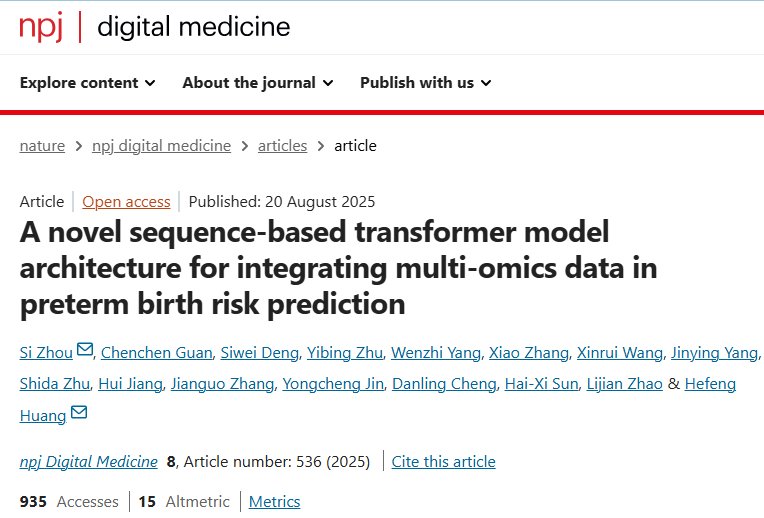
This breakthrough not only demonstrates the unique value of GeneLLM in multi-omics data integration but also opens new directions for precision obstetrics and future biomedical applications.
GeneLLM Large Model Sets New Precision in Preterm Birth Risk Prediction
According to the World Health Organization (WHO), the global preterm birth rate ranges from 5% to 18% annually, and China ranks second in the number of preterm births, with an incidence rate of about 7%.
Preterm infants have underdeveloped organ systems, poor adaptation and regulation abilities, leading to high morbidity and mortality. Identifying high-risk groups for preterm birth as early and accurately as possible during pregnancy remains a core challenge in modern obstetrics.

OxTium Technology's GeneLLM model empowers innovative multi-omics exploration, bringing new hope to solving this global challenge.
This study adopted a nested case-control design, enrolling 682 pregnant women. Plasma samples were used for cfRNA and cfDNA sequencing, and three data input modes were used to build prediction models:
Building Prediction Models
cfDNA single data
cfRNA single data
cfDNA + cfRNA multi-data integration
In this study, OxTium Technology provided key technical support and data analysis capabilities, marking the first time a Transformer large language model was combined with multi-omics (cfDNA + cfRNA).
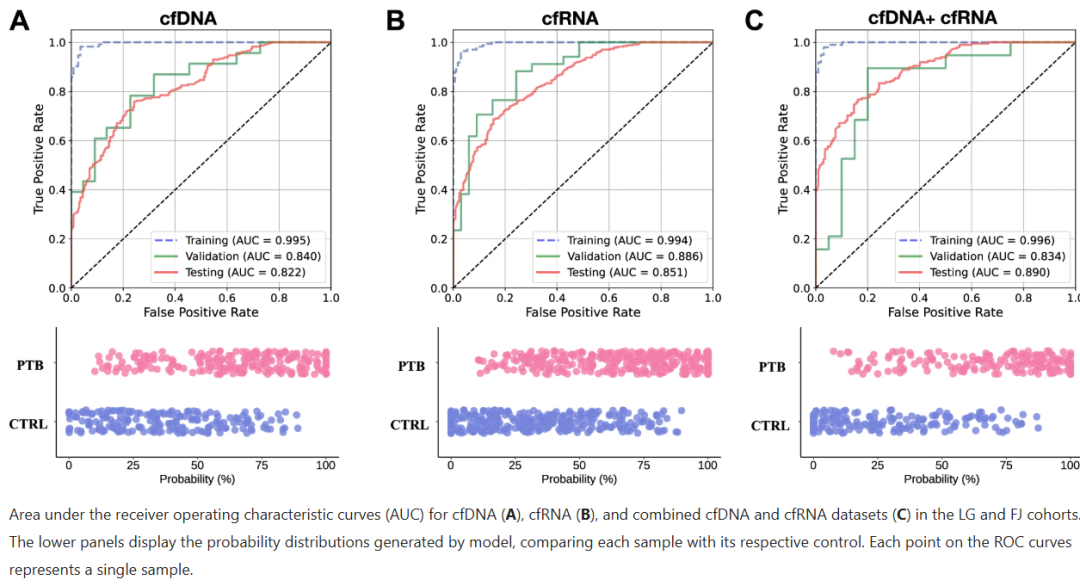
Results showed that multi-omics integration significantly outperformed single-data models. In the test set, the Transformer-based GeneLLM achieved an AUC of 0.890 for cfDNA + cfRNA multi-data integration, significantly outperforming single-data models and surpassing the performance of existing machine learning models.
The study indicates that cfDNA and cfRNA may capture complementary biological signals, thereby improving prediction accuracy.
AI for BioScience Leader, Providing One-Stop AI Solutions
This study is another innovative example of OxTium's AI for BioScience in disease diagnosis and prediction applications.
As a global leader in AI for BioScience, OxTium Technology is committed to the deep integration of AI with medical diagnostics, biomanufacturing, environmental monitoring, and other fields, providing intelligent solutions to research institutions, medical institutions, and industrial clients. Benchmark clients include BGI, Baidu PaddlePaddle, Peking University First Hospital, and Peking Union Medical College Hospital.
Based on the GeneLLM large model, OxTium Technology has built the BioFord™ one-stop bioscience research platform, using AI to reshape the paradigm of biological research; and developed an intelligent experimental management platform for bioscience, driving laboratory research into a new era of intelligent automation.
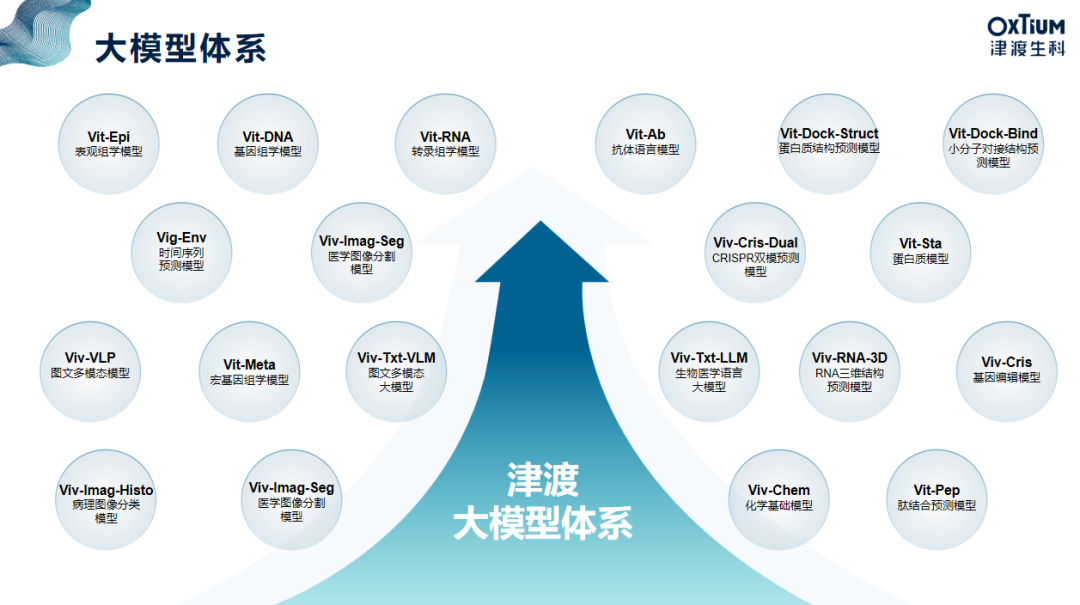
The research results released this time are one of the technological achievements of OxTium Technology's AI for BioScience. Gathering top talents in artificial intelligence, bioinformatics, and other fields, the OxTium team has published over sixty papers in top journals such as Nature and Nature Communications.
OxTium actively promotes cooperation with leading domestic research institutions. Currently, OxTium has established a Medical AI Research and Development Center with Shenzhen Tsinghua Research Institute, a Medical Large Model Innovation Center with MGI Tech, and is conducting medical research collaborations with dozens of tertiary hospitals.
"OxTium is a firm supporter and practitioner of AI for BioScience. We firmly believe that artificial intelligence will become a key force in driving bioscience from experience to precision." Deng Siwei (co-first author of this paper), co-founder of OxTium Technology, stated that the GeneLLM large model will be applied to more fields in the future.
In the future, the company will continue to empower collaborative innovation in research and industry, providing one-stop AI solutions for users in medical diagnostics, biomanufacturing, environmental monitoring, and other fields, accelerating scientific discovery through AI technology, reducing R&D costs, and facilitating the efficient transformation of academic achievements into industrialization.