Xiao Wu Xiang Gong is a powerful inner skill of the Carefree Sect in Jin Yong's Demi-Gods and Semi-Devils.
Its main characteristic is being formless and traceless. With this skill, one can mimic any martial art as long as they know the moves. An outsider might think it's the real deal, and even an insider... well, they might be fooled too.
Take Jiumo Zhi, for example. This martial arts influencer arrived at Shaolin Temple with an air of 'all martial arts under heaven come from me.' He could perform 'Flower Picking Finger' and 'Prajna Palm' with convincing flair.
The Shaolin monks were initially awed, thinking, 'How does this master know everything? Have our Shaolin secret arts become commonplace?' But not all imitations are equal. Jiumo Zhi's Xiao Wu Xiang Gong had flaws. When he faced Xuzhu, who had perfected the same skill, his true colors were revealed—he resorted to using a weapon to sneak attack.
The Sweeper Monk in the Shaolin Scripture Library exposed him: 'With Xiao Wu Xiang Gong as your foundation, you can indeed perform the Seventy-Two Ultimate Arts of our temple. But forcing yourself to practice Shaolin arts without cultivating Buddhist teachings will eventually lead to deviation.'
In other words, 'Your imitation is decent, but something's missing. If you only mimic without building inner strength, you'll eventually crash.'
The Yijin Jing is Shaolin's supreme martial arts scripture, a treasured ultimate treasure. It is the more suitable inner skill for monk masters.
Abbot Fangzheng saw Linghu Chong as a 'destined one' and broke tradition to teach him. After mastering the Yijin Jing, Linghu Chong not only neutralized the chaotic internal energy absorbed by the Huagong Da Fa but also greatly enhanced his power. It's like fitness: building muscles alone isn't enough; you need core strength to stand firm in the martial world. The Yijin Jing is the key to choosing the right inner skill and becoming a 'peerless master.'
As AI sweeps through the medical world, DeepSeek is like Jin Yong's Xiao Wu Xiang Gong—seemingly versatile and applicable everywhere. Over a hundred hospitals nationwide are racing to deploy it. This general-purpose AI large model is rapidly infiltrating health commissions, medical insurance bureaus, and medical institutions at all levels. (Different general NLP large models are like various Xiao Wu Xiang Gong—for instance, Baichuan Intelligence and Baidu's ERNIE Health, which claim to be medical large models but are actually repackaged general models, or the suddenly high-profile Huawei AI Medical Corps—all using NLP large models plus vision large models for scenario repackaging.)
Take Tsinghua Changgung Hospital as an example. According to news, this project leverages existing smart hospital experience and computing infrastructure. DeepSeek, through core business systems like HIS and OA, significantly improves diagnosis and treatment efficiency. It uses AI's powerful logical reasoning and massive information integration to assist doctors in diagnosis, opening 155 ports covering 4,000 computers across three hospital campuses, even reaching affiliated medical units. However, the core of forming a 'DeepSeek medical matrix' is that the medical data sources processed by DeepSeek remain human-readable text, images, and graphics.
This DeepSeek all-in-one, akin to Xiao Wu Xiang Gong, may indeed excel in administrative data tasks—triage, guidance, medical record generation—all in one go, making it an 'efficiency hero' in hospitals.
Yet, when faced with hardcore clinical challenges like genetic data, special pathologies, and specialized medical imaging, it struggles to exert its inner strength. Why? Two main reasons:
1. Complexity of Life Sciences: Although open-source models are powerful, professional discriminative tasks still require expert annotation. Their auxiliary role is limited and cannot replace precise diagnosis. They are like 'nearsighted encyclopedia scholars'—broad knowledge but lacking depth, unable to meet the high demands of bioscience for professionalism and accuracy. From gene sequences to protein folding, from cell metabolism to organ function, the complexity of living systems far exceeds the cognitive boundaries of general models. General models may mislead patients in medical scenarios, causing diagnostic errors. Especially for young doctors, over-reliance may foster laziness and even learning incorrect information, endangering patient safety.
2. General models, though broad, lack deep understanding of scenarios—they seem plausible but are riddled with flaws. Like Xiao Wu Xiang Gong imitating all martial arts, it often wins but fails against true masters like the Sweeper Monk. The more you use it, the greater the side effects, just like Jiumo Zhi's body failing from prolonged forced operation. For example, even with SAM and many medical imaging models, experts know that data varies across sub-scenarios, and models are not fully compatible, often difficult to use. The main reason is that medical diagnosis and treatment are not simple black-and-white, not just discriminative or generative tasks. The 'generalist' nature has limitations when facing bioscience complexity:
Personalized Diagnosis Challenge: The essence of medicine is 'to cure sometimes, to relieve often, to comfort always.' Personalized patient judgment and humanistic care require years of clinical experience, which AI cannot replace.
Data Reliability and Hallucination Issues: DeepSeek's pre-training data comes from massive general corpora, over 30% of which is non-medical content, including news, entertainment, social posts, and even novels. This 'mixed feeding' makes the large model prone to 'deviating' when handling professional problems. AI has no sense of right or wrong; its conclusions depend entirely on source data quality and still require professional verification. Moreover, generative model hallucinations are unacceptable in serious clinical medical scenarios.
So, is there a better solution in biomedicine beyond the DeepSeek all-in-one? Is there a specialized large model, like Shaolin's Yijin Jing, that better matches Shaolin's Seventy-Two Ultimate Arts, integrating internal and external skills seamlessly?
Of course there is!
OxTium Technology's self-developed GeneLLM™️ is an 'AI Scientist' large model designed specifically for the code of life. Its birth marks a disruptive shift in medical AI from 'general efficiency' to 'professional insight.' Starting from raw biological data, it completely solves problems like data interference and semantic errors in general models, achieving end-to-end accuracy improvement.
GeneLLM™'s technical advantages can be summarized in three points:
- Foundation of 23 billion sequencing sequences: GeneLLM™'s training data is not text or images but omics data (DNA/RNA/proteins...), based on raw sequencing data. Through repeated training, it builds a foundational large model for bioscience. This gives GeneLLM™ a unique biological understanding, enabling it to handle complex multi-omics data with ease.
- Penetration across six industry chains: GeneLLM™'s industrial applications are already showing results. The Bioford™ training-inference cloud platform and inference all-in-one, powered by GeneLLM™, cover basic research, medical diagnosis, biomanufacturing, and other bioscience fields.
GeneLLM™'s industrial penetration is equally impressive. It has already reached strategic collaborations with clients like BGI and Shanghai East Hospital. It is not just a foundational biological large model but also redefines the zero point of the global AI healthcare value coordinate system.
Just as Shaolin monks dominate the martial world with the Yijin Jing, Shaolin's martial arts require Shaolin's inner skill to drive them—AI healthcare also needs GeneLLM™ as the inner skill to drive professional applications in the arena.
The emergence of the DeepSeek all-in-one at most marks a key step in ordinary data management for AI healthcare, but it is by no means the final solution.
We strongly urge all leaders in the medical and health system, as well as all colleagues optimistic about AI healthcare, to think calmly—
If Xiao Wu Xiang Gong forcibly drives Shaolin's Seventy-Two Ultimate Arts, it will eventually lead to deviation and 'hallucinations.'
It's like trying to open an extremely complex lock with a master key—not only do you fail, but you also trap yourself.
When we choose a path of cultivation and invest persistently without distraction, once we reach a certain level, we can master our mind and gradually try another path, opening the way for cross-disciplinary breakthroughs.
Similarly, OxTium Technology's original intention in developing GeneLLM™ is to make it an outstanding 'AI Scientist' that accompanies every scientific researcher, empowering innovation and accelerating breakthroughs in bioscience.
GeneLLM™ is not satisfied with superficial process optimization but delves into the levels of genes, molecules, and cells, forging more precise weapons for bioscience research. This is like the ultimate truth in Jin Yong's martial arts world: peerless masters never rely on fancy moves but win through profound inner skill.
The local deployment of the inference all-in-one with GeneLLM™ as the core technology has completed four standard configuration tests: the high-performance training-inference all-in-one uses 8 A100 GPUs with a 72-core CPU; the high-performance desktop all-in-one uses a 64-core 128-thread CPU and 2 RTX 4090 GPUs, with a 15.6-inch HD touchscreen, greatly improving fine-tuning efficiency and inference speed, supporting real-time inference of up to 1.5 billion parameters. The domestic training-inference all-in-one is configured with a 32-core Kunpeng 920 CPU and 8 Ascend 300i/Kunlun GPU P 800, with Ubuntu system and domestic database, meeting the information and innovation needs of various research institutes and clinical institutions.
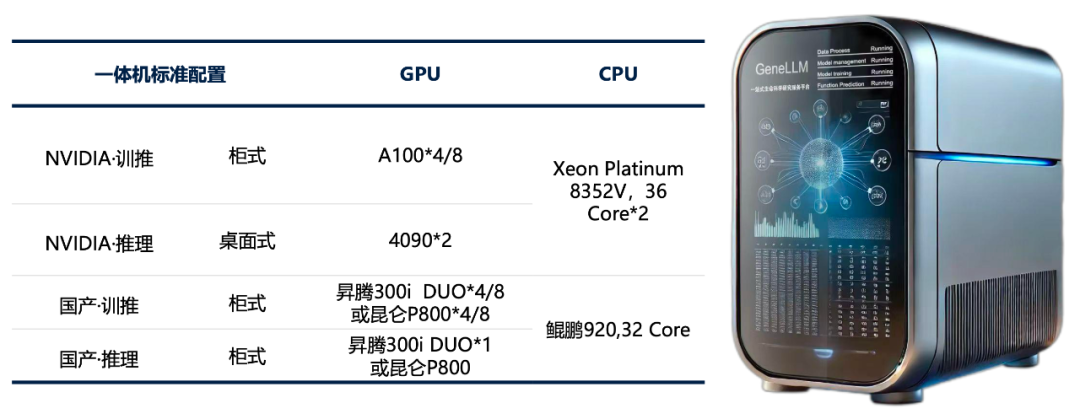
When using small-scale sample data for inference, the Bioford™ inference all-in-one allows scientists to view research results synchronously and make decisions and share based on the overall research plan. Additionally, the platform supports project-level data confidentiality management, flexibly meeting the collaboration needs of different topics and research, and can be deployed locally or in the cloud, fully supporting scientists' bioscience research work.
The future of AI healthcare will undoubtedly belong to specialized models rooted in bioscience-specific 'Yijin Jing'-type models that directly target the essence of life. DeepSeek may be the best among 'generalists,' but GeneLLM™ is the true 'inner skill master' for deciphering the code of life.
General models and biological models each have their strengths, but if we ask who will dominate the future, the answer may already lie deep within bioscience—where what is needed is not the flashiness of moves but the depth of inner skill.